Landing Pages vs. Microsites: How to Choose the Right Strategy for Modern Marketing Campaigns

Many companies invest in marketing campaigns without fully considering how their digital experience supports the desired outcome. High-performing traffic is typically driven to a destination, but that destination often lacks the structure needed to convert interest into action. In many cases, the issue is not the campaign itself, but the decision about the destination to which users are sent and how that experience is designed.
One of the most common strategic decisions in campaign planning is whether to use a landing page or a microsite. While these terms are sometimes used interchangeably, they serve very different purposes. Choosing the right approach can significantly influence conversion rates, user engagement, and overall campaign effectiveness.
Understanding when to use each option allows businesses to align their marketing efforts with user intent, campaign complexity, and long-term growth objectives.
Why Campaign Structure Matters More Than Ever
Modern buyers expect clarity, speed, and relevance when interacting with digital content. When users click on an ad, email, or search result, they expect to find exactly what they were promised with minimal friction. If the experience feels disconnected or confusing, they are likely to leave.
Google research shows that 53% of mobile users abandon a site that takes longer than three seconds to load, highlighting the importance of streamlined, purpose-driven digital experiences.
This expectation has shifted how high-performing campaigns are built. It is no longer enough to simply drive traffic. Businesses must guide that traffic through a focused experience designed around a specific outcome.
That’s why the landing page vs. microsite choice matters. Let’s explore what each is designed to do, clarify its purpose, and share practical execution tips for both.
What Is a Landing Page?
A landing page is a focused, single-destination page designed to drive one specific action. That action may include submitting a form, downloading a resource, registering for an event, or requesting a consultation.
Landing pages are typically used in:
- Paid advertising campaigns
- Email marketing campaigns
- Lead generation initiatives
- Promotional offers
The primary goal of a landing page is always conversion. Every element on the page is designed to support that goal by reducing distractions and guiding the user toward a clear next step.
High-performing landing pages often include:
- A clear and compelling headline
- Focused messaging aligned with the campaign
- A strong call to action
- Minimal navigation to reduce distraction
- Supporting proof, such as testimonials or results
According to WordStream research, landing pages can achieve conversion rates of 5% to 15%, depending on the industry and level of page optimization.
When properly designed, landing pages create a direct path from interest to action.
What Is a Microsite?
A microsite is a small collection of pages that operate as a focused digital experience within or alongside a primary website. Unlike a landing page, which is designed for a single action, a microsite allows for deeper storytelling, multiple content types, and more complex user journeys.
Microsites are often used for:
- Product launches
- Brand campaigns
- Educational initiatives
- Multi-step buyer journeys
- Industry-specific targeting
A microsite provides more flexibility than a landing page. It allows businesses to present detailed information, guide users through multiple stages of the decision process, and create a more immersive brand experience.
Microsites are particularly effective when the topic requires explanation, context, or multiple touchpoints before conversion.
When to Use a Landing Page
Landing pages are most effective when the goal is simple and immediate. If a campaign is focused on driving a single action, a landing page provides the most efficient path to conversion. One purpose = one page.
Use a landing page when:
- The campaign has one clear objective
- Traffic is coming from paid ads or email
- The audience is already familiar with the offering
- Speed and simplicity are priorities
Landing pages work especially well when combined with a marketing-focused website strategy that supports conversion across the entire digital experience.
When aligned with messaging and targeting, landing pages can significantly improve campaign performance.
When to Use a Microsite
Microsites are better suited to campaigns that require more storytelling, enabling more in-depth explanation or greater engagement. When users need additional information before taking action, a microsite provides the space to guide them through that process.
Use a microsite when:
- The offering is complex or new
- Multiple audience segments are involved
- Storytelling is important to the campaign
- The decision process involves multiple steps
Microsites also support brand-building efforts by allowing companies to present a more complete narrative. This can be especially valuable when introducing new services, entering new markets, or repositioning a brand.
Organizations that invest in brand research and positioning strategy often use microsites to communicate their value more effectively across different audience segments.
Landing Pages and Microsites Can and Should Work Together
It is important to recognize that landing pages and microsites are not competing tools. They serve different roles within a larger marketing system.
Landing pages are ideal for direct response campaigns focused on immediate action. Microsites are better suited for education, storytelling, and multi-step engagement.
High-performing marketing strategies often use both approaches together. For example, a campaign may use a microsite to educate users and build interest, followed by targeted landing pages designed to convert that interest into leads.
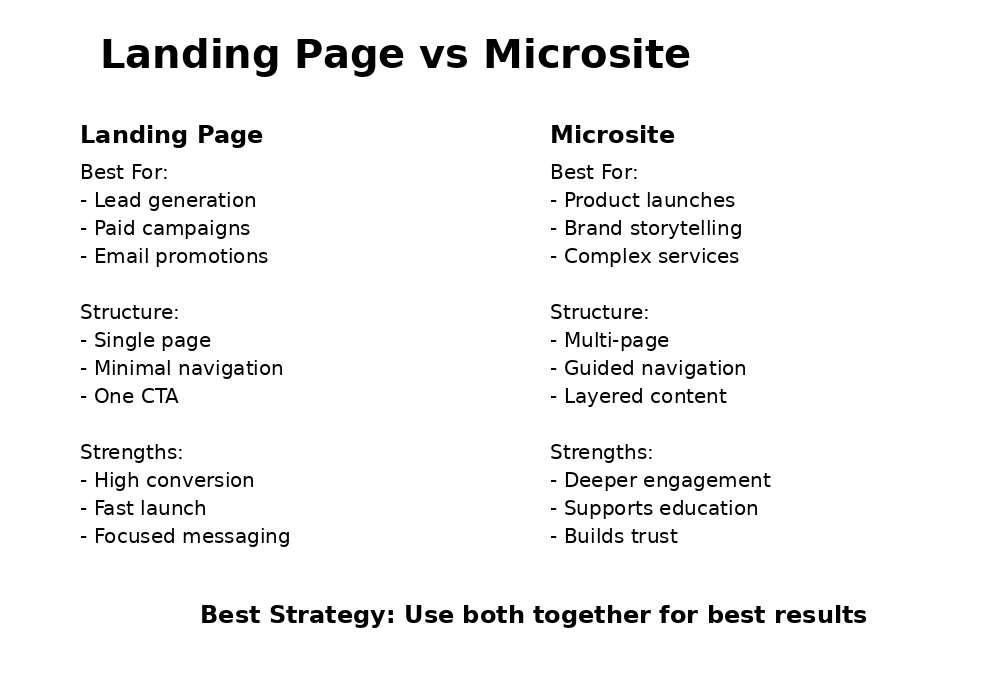
When these elements are aligned, businesses create a more effective and scalable marketing system.
The Role of Messaging in Campaign Performance
Whether a business uses a landing page or a microsite, messaging plays a central role in determining success. Landing pages require message clarity fast; microsites require message consistency across multiple pages. Clear messaging ensures that users understand what is being offered, why it matters, and what they should do next.
Strong messaging helps:
- Align expectations between ads and destination pages
- Reduce confusion during the user journey
- Build trust through clarity and relevance
- Improve conversion rates
Companies that invest in a clear brand messaging strategy often see stronger performance across both landing pages and microsites because their communication remains consistent and focused.
When messaging is unclear, even well-designed pages struggle to convert.
Common Mistakes That Reduce Campaign Performance
Many campaigns underperform not because of budget or reach, but because of structural and strategic issues. It all hinges on setting proper goals and planning intelligent pathways to reach them.
Businesses often focus on driving traffic without fully considering how users will react when arriving at the destination. Ensure the promise in the ad or email is immediately reflected on the destination page so expectations are met upon arrival.
Common mistakes include:
- Sending traffic to generic website pages
- Using inconsistent messaging between ads and pages
- Overloading pages with too much information
- Failing to guide users toward a clear action
These issues create friction, reducing conversion rates and weakening campaign effectiveness.
Research from HubSpot shows that companies that prioritize conversion optimization are more likely to achieve higher ROI from their marketing efforts.
Addressing these challenges requires a strategic approach to both messaging and digital experience design. An experienced marketing agency partner can be an invaluable guide in improving results.
Why DIY Campaign Structures Often Fall Short
Many organizations attempt to build landing pages or microsites using templates or low-cost solutions. While these tools can produce functional results, they often lack the strategic depth needed to maximize performance.
Common limitations include:
- Limited understanding of user behavior
- Weak alignment between messaging and design
- Lack of conversion optimization strategy
- Minimal integration with broader marketing systems
Freelancers and low-cost providers may deliver individual components effectively, but without a coordinated strategy, campaigns can feel disconnected, leaving visitors confused or misled.
This leads to experiences that may appear complete but fail to guide users toward taking meaningful action.
The Strategic Advantage of an Integrated Agency Approach
Experienced marketing agencies approach campaign development as a coordinated system rather than a collection of individual tasks. They consider how messaging, design, user experience, and data all work together to influence outcomes.
An integrated approach typically includes:
- Audience research and segmentation
- Messaging development aligned with positioning
- UX design focused on conversion
- Performance tracking and optimization
This structure helps ensure that landing pages and microsites are not only visually appealing but also strategically effective.
The proven RPS strategic marketing approach works with businesses to design campaign experiences that align with their broader marketing strategy and growth objectives.
Final Thoughts
Choosing between a landing page and a microsite is not simply a design decision. It is a strategic choice that influences how effectively a campaign engages users and converts interest into action.
Businesses that align their campaign structure with user intent, messaging clarity, and conversion strategy often achieve significantly stronger results from their marketing efforts. Instead of relying on isolated tactics, they build systems that guide users through meaningful experiences.
RPS has helped organizations develop campaign strategies that combine messaging, design, and user experience to improve conversion performance and drive measurable growth. If your business is planning a campaign and wants to ensure it is structured for success, schedule a strategy conversation with our team.
Start building smarter campaigns today.